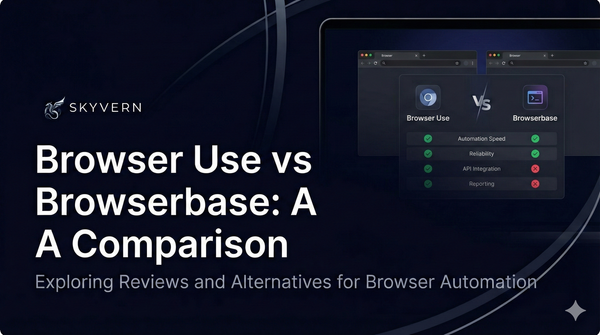
Comparisons Browser Use vs Browserbase: my honest comparison Browserbase and Browser Use can both automate work in a browser, from collecting product data to filling out forms. Choosing between them comes down to what you want to build: a task you hand to an AI agent, a custom agent inside your application, or browser infrastructure for scripts you
Comparisons 6 Stagehand alternatives for browser automation in 2026 If you're looking for Stagehand alternatives, you probably want an AI browser agent that: * Works natively with Python scripts. * Can navigate and scrape complex websites efficiently. * Stays reliable as your workload grows from a few runs to thousands of browser jobs. That's the kind of workflow
Comparisons Browser Use vs Stagehand: Which One Should You Pick? Browser Use and Stagehand both let you use AI to automate browser tasks, such as collecting product data or filling out forms. When you’re deciding which to build with, their feature lists only tell you so much. You want to know how much code you’ll need to write,
Comparisons Skyvern vs Browser Use for Browser Automation If your team spends hours moving between portals, downloading invoices or filling out the same forms, you probably already know what you want to automate. Choosing between Skyvern and Browser Use comes down to how you’ll build it and who on your team will keep it running. I’m
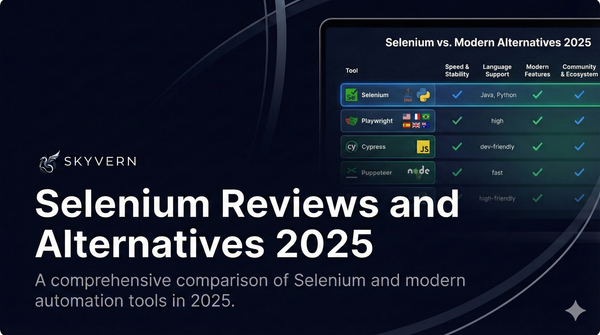
Comparisons 6 Selenium Alternatives for Faster Browser Automation Here is my guess: you are tired of fixing scripts that break every time a website changes its layout and you are looking for an alternative. Selenium has been the most popular testing framework for years. It’s open source, it runs tests across every major browser, OS and language.
Comparisons 7 Playwright MCP Alternatives for Better Browser Automation Compare seven Playwright MCP alternatives that reduce context overhead, retries, and stalled agent runs. Find the right option for your workflow.
Comparisons 9 Prior Authorization Companies Compared (2026) Compare nine prior authorization companies by workflow coverage, setup, human review, who each product serves, and the work each leaves to your team.
Comparisons 9 Browser Use Alternatives Compared for 2026 Compare nine Browser Use alternatives by operating model and setup, including Skyvern, Stagehand, Playwright, and Steel.
Comparisons Best Open-Source Browser Automation Tools for 2026 Compare 8 open-source browser automation tools for testing, AI agents, managed browsers, and web data, with practical guidance on choosing the right one.
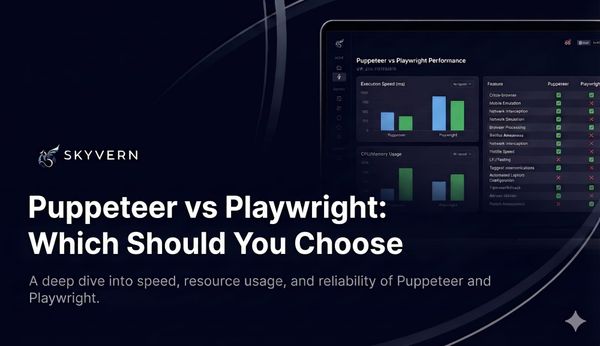
Comparisons Puppeteer vs Playwright: Which Should You Choose? (Benchmarked) Compare Puppeteer and Playwright by browser coverage, test tooling, maintenance, and benchmark limits to choose the right automation library.
Comparisons Airtop vs Skyvern: Head-to-Head (August 2026) Most browser automation comparisons treat every tool as a variation of the same thing. Airtop and Skyvern aren't. One is cloud infrastructure for developers who want to manage their own agent logic. The other is a goal-directed execution platform built for ops teams running portal-heavy workflows
Comparisons CloudCruise vs Skyvern: Side-by-Side (August 2026) Most browser automation comparisons focus on features. The one that actually matters is what each tool does the first time a portal renames a button or adds a new login step. CloudCruise and Skyvern answer that question very differently, and your answer should probably follow from theirs. That question is
Comparisons Firecrawl vs Skyvern: Key Differences (July 2026) You're trying to automate something web-based and you're weighing your options. Firecrawl and Skyvern both come up, they both handle browser content, and it's not immediately clear what separates them. But the architectural gap between the two is considerable: one reads public pages
Comparisons UiPath vs Skyvern: Full Comparison (July 2026) Every RPA comparison of Skyvern vs UiPath tends to stack feature against feature, but the more useful question is what breaks first when a vendor updates their portal without warning. If your workflows run on stable internal systems like SAP or Oracle, that question barely matters. If they run on
Comparisons Sola vs Skyvern: Which is Better for Browser Automation? (June 2026) You're comparing Sola vs Skyvern because you need to automate workflows that live on portals with no API, and you're tired of scripts that break every time a vendor updates their layout. The pitch for both tools sounds similar: automate browser work without writing code. But
Comparisons Kernel vs Skyvern: Which is Better for Browser Automation? (June 2026) You've got a workflow that runs on a portal with no API, requires credentials that rotate, and breaks automation scripts every time the vendor updates their layout. Kernel provisions clean, fast browser sessions in 300 milliseconds and ships anti-detection configuration out of the box, but you still
Comparisons Browse AI vs Skyvern: Which is Better? (June 2026) Every browser automation comparison eventually comes down to one question: does your workflow require more than pulling data off a page? The Skyvern vs Browse AI decision breaks along that line. Browse AI records your interactions once and replays them as long as the page layout stays consistent. Skyvern reads
Comparisons Axiom vs Skyvern: Which Browser Automation Tool is Better? (June 2026) Choosing between Axiom and Skyvern for browser automation means choosing between two fundamentally different approaches to handling the fact that websites change. Axiom records a workflow once and replays it using selectors tied to the page structure at that exact moment, which works until the site updates and breaks the
Comparisons Stagehand vs Skyvern: Which is Better? (June 2026) You automate a workflow once, and three weeks later the portal moves a button and your script breaks. That's the maintenance cycle everyone who's tried browser automation has lived through. Stagehand tries to soften that cycle by letting you mix stable selectors with AI-powered fallback
Comparisons Director vs Skyvern: Which Browser Automation Tool is Better? (June 2026) You've narrowed it down to Director vs Skyvern for browser automation, and now you need to know which one survives contact with real workflows. Director turns plain-language prompts into executable scripts anchored to selectors, so every time a portal renames a button or restructures a form, someone
Comparisons Anchorbrowser vs Skyvern: Which Browser Automation Tool is Better? (June 2026) Anchorbrowser gives you cloud browser infrastructure you script against. Skyvern reads pages visually and acts on goals you describe in sentences. The difference shows up immediately when sites change: in the anchorbrowser vs skyvern scenario, one requires you to fix broken selectors manually while the other re-parses the page
Comparisons Steel vs Skyvern: Which is Better? (June 2026) Steel and Skyvern both solve browser automation problems, but they sit in completely different parts of the stack. Steel is infrastructure: it manages Chrome sessions and gives you an API to script against, but the automation logic stays your responsibility. Skyvern is end-to-end execution: you give it a
Comparisons Automation Anywhere vs Skyvern: Which is Better? (May 2026) The Skyvern vs Automation Anywhere decision turns on one structural difference. Automation Anywhere builds workflows around pre-mapped selectors, so every portal redesign means someone on your team reopens the bot, finds the broken element, and redeploys. Skyvern reads pages visually at runtime, identifying buttons and fields by appearance instead
Comparisons Skyvern MCP vs Hyperbrowser AI: Complete Comparison for May 2026 The Skyvern MCP vs Hyperbrowser AI question comes down to whether you need a faster way to run the automation you've already written, or a way to stop writing it in the first place. Hyperbrowser solves the infrastructure side: managed browsers, stealth capabilities, session orchestration, all accessible through
Comparisons Skyvern MCP vs Selenium: Head-to-Head Comparison (May 2026) The debate around Skyvern MCP vs Selenium comes up constantly, and the answer depends on what kind of maintenance burden you can stomach. If your site never changes and your selectors stay put, Selenium still works. But cross-portal workflows, frequent UI updates, and third-party sites that redesign monthly